
Ronin
Creating Character
Kii Peninsula
I rolled into the McDonald's to the resounding customary welcome—いらっしゃいませ! (Irasshaimase!). The restaurant was tucked into the shopping strip running along a generally bustling pedestrian mall, but one now quiet as a grey evening sky shed its heavy rain. The road ran straight from my apartment down to Wakayama City's main arterial road, at the base of which stood city hall and the town's main (three-star) hotel. Beyond them was the city's central spine—the highway which ran through it and then down into the lush sub-tropical countryside of Wakayama prefecture. On the other side of that avenue rose Wakayama Castle—a replica of the one which stood there before the war and which once housed branches of the elite Tokugawa Shogunate.
I'm not sure now why I'd stepped out that afternoon. Alone in my apartment, I was probably just a little stir-crazy and needed some air. My time in this provincial town an hour south of Osaka on the coast of the Kii Peninsula was running down, and in a few months I'd be on a flight back to Toronto after having spent two years teaching in the city's junior high schools. I was twenty-three years old in the late winter of 1993.
I'd just gotten into the Norman Paterson School of International Affairs at Carleton University in Ottawa. The wind was at my back again and I had that confident air again—of someone whose path, a moment ago uncertain, was once again laid before him. This was where Canada's expatriate non-governmental, corporate, and diplomatic corps immersed themselves in the study of political economy, conflict, and development in the global context; where they sought to understand ideas concerning loyalties to arbitrary concepts of nationality, faith, and tribalism in all its forms and how they impacted prosperity and standing in an increasingly complex and transnational global reality. A year from now I would be submerged underneath a torrent of reading—technical journals—not to mention examinations, writing, and the competitive parry and riposte of debating with self-styled Marxists in class. I would become the class bête noire, broadly typecast (in my view, badly) as a right-wing libertarian with shadowy connections to India's new (and supposedly fascist) government. Mostly, I think because I was brown, pro-markets, and thought gender to be a grammatical rather than biological construct. It didn't help that I was literally English and spent time in places like South Korea and Japan (rather than, say, Senegal or Benin). In later years I would prefer to spend money having high tea with my daughters instead of making charitable donations to Haiti.
Here and now, though, the deflation I felt just days earlier was lifted. A backup plan had fallen through when the London School of Economics turned me down; I was bracing myself for further disappointment, as induction into Norman Paterson was every bit as hotly contested, even if its cachet was mostly domestic. So far, the University of Essex's program in Japanese Studies in Colchester, as well as Simon Fraser's graduate program in Political Science, had emerged as options, but now I was really on my way.
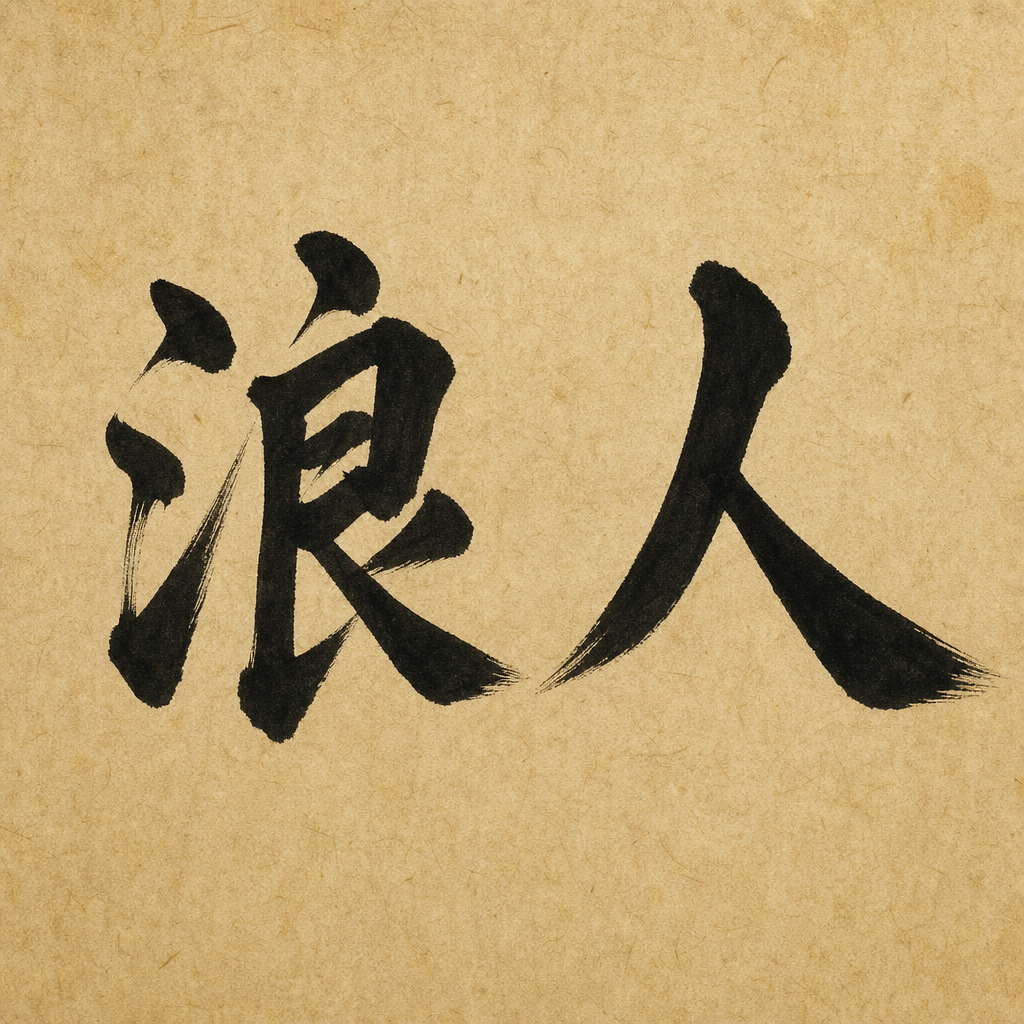
Like many people, I was then still mentally bound to identity as being synonymous with an aspect or chapter in one's life. The first question you usually encounter in a social setting, after all, is: "What do you do?" Looking back, though, I have to say I've always been a student of that one constant examination that is life itself. Whether as a child or as a parent, a professional or an amateur, I moved fluidly as a particle set upon the flow of wave motion that is life; a rōnin (浪人)—free as a monarch to float like that butterfly because I was self-possessed as well as unclaimed.
I was hungry again for intellectual growth, having worked off my undergraduate burnout in this quietly bustling provincial town. It had served as a hub as I reached into the most beautiful places both right here in the prefecture and beyond throughout Kansai—as well as in South Korea, Thailand, and Malaysia. For me, however, nothing was ever so beautiful, elegant, and tasteful as Wakayama-ken and, more broadly, Kansai with all its bristling cultural breadth—Koyasan's complex of austere monasticism perched high in the mountains chief among it. Negotiating the hairpins on the way down from that Buddhist enclave, we stopped for a while at a motoring lookout point, and my eyes welled up as I gazed out at an assorted range of pastel-layered pink and purple mountain ranges, the sky still faintly kaleidoscopic with the particulate haze of Pinatubo's eruption two years earlier. I was emotionally overcome by the sight.
I now had new options with which to delay my inevitable entry into the next stage of life; I wasn't ready to commit to a career or the intimacy of a relationship. I had been too serious a scholar at school to date much at Western University; I made up for that in spades here in Japan—but without really committing. It's amazing what finishing a degree, even just a Bachelor's, and then landing a well-paying gig did for one's prospects—especially if you were decent—being handsome and taking good care of yourself didn't hurt, either.
My job with Monbusho (Japan's Ministry of Education) paid a startling $45,000 a year—a lot of money for a twenty-one-year-old in 1991. Over the past two years, I had also ridden the wave of foreign direct investment into Southeast Asia, investing my savings into Jardine Fleming's emerging market funds. That was still an exotic thing to do for a suburban middle-class kid—not at all mainstream fare. Risk was something I've come to think of in stark, binary terms: there is life and there is death. Money has little to do with either because so little these days is required to live a good one, if you have transacted with the world in high-fidelity so as to inhabit a personal culture which feels abundance rather than hoards it. The stellar returns I generated from my investment amply funded me as I went back to school over the next couple of years. Several years on I still had the money to make a down payment for the two-acre estate we still live on some thirty years later.
More than any prospectus detailing past performance and future forecasts, I was taken with Jardine Fleming's swashbuckling and history fictionalized and retold by James Clavell in his novels Tai-Pan and Noble House. These I devoured in pretty much a single sitting over a winter weekend while bingeing on mikan (tangerines), ramen, and mugi-cha (roasted barley tea). I read a lot in those days, devouring page-turners that offered easy escapism when the solitude of being away from the familiar environs of home became overwhelming. This wasn't Tokyo, Osaka, or Kyoto with their expatriate milieus.
The World Wide Web hadn't arrived yet and the dot-com boom was still years away; it still took a bit of effort to put yourself "out there" and it didn't always feel worthwhile—especially for an introvert such as myself. However, whatever you did put out was the transparent truth of who you were. These were still times when you could disappear into the obscurity of another continent on the far side of the world, and that was exactly what I'd done these past two years. Largely alone here in my apartment, I had only the fixed line of my rotary phone connecting me to the outside world. Otherwise, there was my Sony shortwave radio and two periodicals (The Guardian Weekly and The Economist). These I read cover to cover in short order as soon as they fell through the mail slot in my door.
I also remember driving right through Douglas Adams' trilogy (in five parts), The Hitchhiker's Guide to the Galaxy, in a single weekend. Joe Jackson's Greatest Hits played on repeat on my stereo—to this day, the soundtrack to the film running in my mind.
All in all, this had been a time of decompression, introspection, and reflection. That said, I had no clear sense of what I wanted to do for the rest of my life. What I imagined was a roadmap involving a bit more school, then vague notions of a career in the diplomatic corps or investment banking—certainly not information technology. I'd been offered the option of a third year here in Japan, but I felt it was time to move on. A hefty wage has never been enough to keep me set on a course if I was set on change.
Man In Society
I looked forward now to returning to the theoretical and data-oriented world of academia. I worked hard at school. I was—and remain—insatiably curious; I loved learning and threw myself into my studies in the most holistic sense. It was never merely about grades, though I certainly scored high ones. I even looked back at high school and marveled at what an extravagantly good deal it is: all that quality education, entirely free. What a privilege; what a launchpad. What a thing each of us makes of such an opportunity—or wastes entirely.
School takes its toll on you when you take it seriously. Yet hard mental work steels you when you persevere through it. It's hormesis; as though you are being folded, pleated, and forged like the sharp edge of a blade—God only knows to what utility; a purpose revealed to the introspective in time.
My work here in Japan was generally a lot of fun, though the effort could be mentally exhausting. We were expected to team-teach with Japanese teachers of English. We offered these colleagues a rare opportunity to dialogue with native speakers. I was determined to spend as much time as I could helping them to develop their ability—much of which rests on confidence and a willingness to look foolish; we in the English-speaking world are particularly good at seeing mistakes as the best thing there is. It's something I found Japanese and in fact Asians generally struggle with a bit—it holds people back, this inability to be vulnerable, naked in the nourishing rain of life that generates growth with automaticity.
Most of my expatriate friends were assigned a single school in a rural district, whereas I made my way through Wakayama City's eighteen junior high schools over the course of a year, spending two weeks at each—a situation which made it difficult to hit a routine involving consistent, structured lesson plans. I became more of an ambassador, making myself available to the wide-eyed youngsters in what was often a first encounter with a foreigner. I joined them on field trips (including one to the absolutely astonishing Osaka Aquarium) or just knocked a ball about in football practice after class. I also got close with the teachers—not just the ones who taught English either—spending many memorably lugubrious nights carousing or singing karaoke.
Many of these teachers were fascinated by the sheer number of idioms and paradoxes in our language. It was really only after working in Japan that I came to see just how bizarre and complicated a mongrel hash English was, and as well how many contronyms or Janus words it encompasses.
Japanese, meanwhile, along with Arabic, is widely considered one of the most demanding languages for an English speaker to master. I spent countless hours studying its calligraphy, creating cue cards while fastidiously abiding stroke order and practicing writing them in the Japanese mode with my finger in the air. I used J.W. Heisig's method for creating memorable narratives with which to sear them into memory. I wasn't so much interested in mastering Japanese as in understanding at a visceral level what it was like to think in Japanese. By the time I departed, however, I was competently conversant. Decades later, all it took was a couple of days of brushing up for me to take (and survive) a phone interview for an EA Sports project management gig. Even now, all it would take me is a month in Japan and I'd be pera-pera (fluent).
Learning a language so different as Japanese has also made me a disciplined, deliberate, and thoughtful practitioner of English rhetoric. As well, my time in Japan transformed me—from being an ordinarily competent individual into someone with a distinct profile.
Physically, I was in the shape of my life. I spent some two hours a day whizzing around on my mountain bike. I weight-trained regularly and practiced Karate, securing a brown belt during my time in Wakayama. The ability to exude confidence in the midst of ambiguity and uncertainty is a valuable trait, and I acquired much of mine in Japan.
I was also flush with cash. I'd worked summers all the way through my undergraduate years at the Richmond Hill Country Club. At first, washing dishes and bussing tables, then as a waiter, bartender, and a bouncer at the club's wedding parties. I had accumulated very little in the way of debt by the time I graduated in the summer of 1991. Then, barely a month or two after graduating, I was on a flight bound for Japan, getting oriented alongside hundreds of international, bright young things from across the English-speaking West at Tokyo's swank Keio Plaza Hotel before setting out across the country to take up our posts.
Maku-donah-rudo
That's how you pronounce McDonald's in Japanese, by the way. At the restaurant's counter, I waited. Beyond it, the grill and fryer emitted their heavy, rich fragrance. I breathed it in as a cheerfully enthusiastic employee rolled up to take my order. He then gestured me toward the stairs to the second floor. I climbed up the narrow stairwell, my mood lifting at the prospect of the meal. I soaked in the lit-up warmth and took a table by the floor-to-ceiling window overlooking the grey street with its incessant rain.
I had U2's Achtung Baby running on my Sony Walkman; the sleek device, scarcely larger than the cassette tape itself, was a premium product I'd bought in Osaka's electronics district—a long way from the garish plastic one which I once owned and that had made the product such a hit in the 1980s. A quarter of a century working in software development has given me a greater appreciation for the quiet and steady iterative process that goes into the evolution of well-engineered things.
Here, now arriving up the stairs, is my good man carrying a tray of food. He sets it down in front of me, steps back, and bows deeply, almost obsequiously. Taken aback, I smile and nod my thanks. I take his genuine appreciation of my patronage at face value. I'm grateful to be in his care this afternoon.
Suddenly I'm emotional, already reminiscing about this country, its people, and my time here. I could see myself blending into its everyday reality and becoming a part of it permanently. I would return twice. All in all, I spent four years in Japan.
My meal—a combo piping hot, delicious, American, and globally renowned—was not something you would want to eat every day at any age.
Epilogue
浪人—rōnin—is a compound phrase meaning masterless samurai. Its constituent kanji are those for wave and person. In contemporary Japanese it also refers to a student who has missed university entrance exams and takes a gap year to study alone before trying again—one who is rudderless and seeking direction. The first character is instructive because our situation in life is always fluid in some respects; as in that famous Japanese painting by Hokusai, we are cast upon the world as though hemmed into a boat on a tempestuous sea.
The second character suggests, to me at least, shelter—some safe and secure perimeter—a roof or a teepee. The handwritten version of that character implies a person walking with deliberate purpose, leaning in with intention. The masterless samurai stands well enough, but his sense of purpose isn't tuned into creation until he's dialed into himself. His deepest question is not how, but why. Why do I exist?
I hadn't earned the right to ask it yet at twenty-three—not with any seriousness. But the shape of the question was already there, in the McDonald's on that quiet grey street, in the pastel mountains below Koyasan, in a rotary phone that rang for no one except me. The way my family has migrated across the planet over the generations, and the way I am embodied yet constantly in transition through my own life makes me a rōnin.