
Tenuous
The New Hobbesian Reality
Heartland
Here comes another winter of long shadows and high hopes
Here comes another winter, waitin' for utopia
Waitin' for hell to freeze over~ The The (Heartland)
The President of the United States is no man for our Old Country. That must be the mantra as we look for breadth in our nation's social graph and in particular cast towards the British Commonwealth and the European Union. If Americans thrive on selling the 'new and improved' we may counter 'sometimes the old ways are the best'.
It's an odd ally that suggests we may not have cordial independent relationships with other nations but as Maine Senator Susan Collins's remarks suggest it's broadly shared by a panicked American leadership. One identity however that Canadians may draw upon for legitimacy is as British North Americans; one whose constitutional framework affords systemic integration and community if not necessarily reconciliation—the one file above all which must be a priority—but one which remains unopened as we seek to restore a working relationship with our closest friend and ally the United States.
Prime Minister Mark Carney recently admitted to assessing war scenarios with the United States. This would have been unthinkable five or ten years ago, but in the current volatile atmosphere—a pervasively fearful one—these are worthwhile thought experiments. They prompt us to consider what war actually is and how it might already be in the midst of being conducted if one's dogma concerning economic matters were driven out of the fear of scarcity and loss.
War may be seen as an attempt to accumulate wealth and standing—through the exercise of influence, power, and authority—and as well possibly through violence. Today more than ever however we are less prone to drawing a line between violence and non-violence, seeing instead a continuum in which one becomes another. The matter then becomes drawing clear distinctions with analytical methods emphasizing utility.
The use of actual military force by the United States against Canada however remains unimaginable. For the only nation that actually used atomic weapons to turn nearly a century later upon its neighbor—the first country to unilaterally renounce nuclear arms—would be a calamity for the human experiment.
With outright war unthinkable for most Americans however, the Trump Administration has instead interfered in other ways to exert influence over Canada. This month Alberta begins to explore potentially leaving Canada—the initiative which has at its root the angst of long-standing grievances flourishes anew. Deep economic and media integration with the United States is now jacked up on a social network which allows for instant and reactive serve and volley tit-for-tat escalation.
U.S. political narratives, funding, and media commentary cross the border organically, heavily shaping Canadian public opinion, protests, and political rhetoric. U.S. Treasury Secretary Scott Bessent called an independent Alberta a natural, energy-rich partner for the United States, suggesting the province could potentially join the Union. That remark is one of many tactical forays across social media channels designed to foment distrust and disunity in Canada. And it is working: for example an Alberta man was recently charged with issuing open death threats against the Prime Minister.
An adversarial posture towards Russia, largely a result of our membership in NATO along with the United States means that we're also compelled to counter those narratives as well as more serious cyber-security operations—in addition to those from Iran and North Korea. It's as though the United States, Russia and its 'Axis of Evil' allies were united in the aim of undermining Canada. It is truly a bizarre and even historic situation—one which has even moved the European Union to offer associate membership.
The war is being waged not through armored divisions but through the deliberate cultivation of social animus, regional resentment, and digital extraction. When hard geopolitical conquest becomes untenable, statecraft instead degenerates into a low-intensity campaign where everyone seeks to shade frenemies on social networks or extract monetary advantage from domestic fractures. Physical annexation is rendered obsolete when a sovereign neighbor's social cohesion can be dismantled from a keyboard to extract monetary value one identity at a time.
Notwithstanding that the United States is supposed to lead Canada and other liberal democracies as an exemplary partner in both war and a free market-oriented peace the administration's primary weapon is instead an aggressively protectionist trade policy—rhetorically, at least.
Protectionism has long been Donald Trump's refrain; an earlier iteration of the man on The Oprah Winfrey Show in the 1980s spoke of the hollowing out of America's industrial heartland and the need to protect good, well-paying jobs for ordinary people. However some forty years have passed since then, and the world is a profoundly different place.
Attention Tension
Our social network’s true currency—the only resource each of us actually trades on it by resonating meaningfully for better and worse—is attention, alongside the physical energy required to sustain it—the calories or kilojoules we consume and burn. We are gradually realizing that time is our only currency and that people are constantly chasing it to make money.
However look around your space and you will see remarkably little that retains lasting value or demands replacing if cared for and used properly; and you really begin to wonder why people are so intent on spending ever-dwindling time on earning and accumulating money and things that it buys.
If anything possessions like our bodies themselves are a burden—it's enough to carry that one demanded of us—rather than add to it with the idea that it makes us more. They demand an ongoing expenditure of attention while restricting our autonomy and sense of ease. Our key objective is surely to eliminate or reduce to the extent possible any extraneous expense so that we might be with and do the things we love. As well given the impact consumption has on our ecology we owe it to our children—what must they think of us but are too afraid to say?
At any rate that is a new mentality slowly unfolding in the world. The nature of our social networks and their enablement of both hedonic experiences and utilities (through Spotify, Netflix, Airbnb, Uber etc.) is that we will need fewer durable hard goods—first to disappear were DVDs and CDs. Now following them are cars, refrigerators, televisions, and even homes—along with the raw materials required to build them. Soon enough all we'll need is our mobile device, a laptop, a backpack and a change of clothes. Maybe we'll drift with our loved ones or maybe we'll stay in one spot. That's up to us.
This shift marks a fundamental departure from the industrial consumer engine of the twentieth century. Today society no longer depends on the accumulation of even a physical form of money. This then presents an enormous opportunity for each of us to minimize the toil required to buy and gather dross—to instead have the depths of experience which makes lives worthwhile. That's the imperative at a time when suicide and misadventure loom as major causes of death—for even our most affluent people.
Cultural conservatives aside (and many still are avid supporters of the President) young people struggling to find the space, time, and money to self-actualize are increasingly forgoing children and long-term intimate relationships altogether - perhaps seeking instead to pursue shared creative pursuits in collaborative spaces. They see little reason to invest in an economic machine led by an incumbent far wealthier generation; one which is increasingly geriatric and seemingly intent on destroying their true inheritance: a livable planet.
Meanwhile the rest of the world is still intent on harvesting our data but as we build lives filled with experiences rather than things we become less susceptible to the manipulation which plays on our insecurities to trigger expenditures - whether on retail therapy or on arsenal.
The shift away from consumerism, which with our enormous dependency on the US economy may as well be US-dollar-denominated—since it's what everyone else prefers we use in trade, even Russia—removes the only lever for influence the United States has on Canada. This is unsettling for them. The result is a constant stream of put-downs. This is why the Prime Minister speaks of war.
The President will say it's nothing personal—and the obviously cordial even friendly demeanour in the Prime Minister's company suggests the whole thing is a game of Risk played with his peers.
While he's intent on securing jobs for his constituents he must begin to appreciate that even the few goods we still want can increasingly be manufactured by automated systems with greater precision and quality assurance—unburdened by expensive entitlements and a burdensome middle-management replaced by a smaller AI-enabled workforce—in places far less expensive than Canada, never mind the United States.
The President is a product of his times, and one far too immersed in the daily firefight of retail politics and that all-important matter for western ideologues—the cost of energy and in particular gasoline—that critical item none of us can reasonably be expected to pay a lot for. Such are the demands on our dwindling purchase power in this age of digital marketing to truly reflect on a future where fewer things are bought and sold. Nor does he reckon with a reality in which the United States—representing just 4% of the world's population—can no longer weaponize its currency to dictate terms to the rest of the globe.
What becomes of soft-power influence—not just over countries, but over their intelligentsia, who no longer care about traditional forms of money, or for whom the accumulation of physical objects seems absurd—who work because it is meaningful and not toil?
Furthermore, what remains of America's philosophical foundation to a Canadian or a Briton when Edward Snowden remains exiled in Moscow for reporting that the U.S. Government and its National Security Agency were breaking their own laws?
Faustian Bargain
So the United States finds itself in a dicey position, struggling to define the country as an idea that attracts people from Norway rather than, say, Haiti even as its main product, the currency itself, loses a comparative advantage enjoyed for close to a century.
While the rest of the world's productivity and society are disciplined by the need to create or extract real things in exchange for the money required to purchase the things others offer. The U.S. alone possesses what Valéry Giscard d'Estaing, de Gaulle's finance minister, termed an "exorbitant privilege"—the ability to literally create the currency as it required and which we all use in global markets. This was in any case a Faustian bargain. The country's people like many in the developed Western world moved increasingly into service and information industries and away from farming (agriculture) and the crafts (manufacturing)—those people of course like any other began to prefer foreign products which were demonstrably better. If you focus on making money everyone else will focus on making real things—and one tends to get good at the things one focuses on.
This bargain (if you can call it that) is becoming harder to maintain as new protocols begin to prove their value. Currently 85% – 90% of global transactions run on SWIFT. For ordinary people sending wire transfers the costs are 11-15% of the amount being sent. Whereas new Blockchain and Stablecoins transfer money at virtually zero cost. Currently the only cost involves ramping money on and off these parallel systems.
On global capital markets we have numerous perimeters not just one single US dollar regime. So there is nothing stopping other countries with large and sophisticated financial entities such as Canada's (which has stolen a march on the US with utilities such as Chip and Pin and Interac) from moving apace to adopt these new protocols to enjoy a massive fillip in efficiency. This then goes on to benefit the entire economy in lower prices and less crime (fraud, money laundering, terrorism, unregistered weapons etc.). Now, the United States obviously has some difficulty with Canada being an even more pleasant and prosperous place than it already is. They won't tell you but the 'Moving to Canada' is very problematic branding wise for the Hegemon—a country with any number of beautifully diverse places to live in—but none that Canadians increasingly find particularly appealing, even to visit.
Thrifty First State
We are at war, make no mistake—but it is a war over culture, identity, and global brand. At some level we've always known this. Our existence irks a lot of Americans. In their ontology, seen through the simplistic, real estate-driven lens of property and dollars, we are ten times richer than they are because we have one-tenth of the people in a country about the same size. We have just as much land, but far fewer souls to divide it among.
To compete while maintaining the discipline required to observe our shared thin red line, we need our own ontology—one that is firmly Western yet speaks to the minimalist elegance of our indigenous heritage. I look to the civil service and the legacy of Arthur Kroeger. I look to my alma mater, Western University, whose motto is Veritas et Utilitas (Truth and Utility). That is as elegant a formula as one can imagine to build Firmitas: a structural integrity and fairness as refined and unpretentious as our finest public buildings.
In Canada, much of the foundational work of governance is carried out by people who view themselves as public servants—whether in the traditional civil service or in the private sector—measuring success against the genuine needs and quiet contentment of our people.
Yet it is difficult to discipline an economy whose participants act simultaneously as consumers and citizens. Their atomized behaviors are rarely aligned. They are constantly torn between individual cravings and community obligations—demanding low prices, quality, and hedonic variety on one hand, while asking for abstract notions of civic virtue on the other.
Our networks monetize this split—using ad-driven algorithms to discover exactly when we're susceptible to retail impulses. As dutiful citizens - denizens of institutions corporate and otherwise we transmute human focus into capital - as much as possible - profit is the incentive.
The result is a socially engineered Hobbesian war of all against all. The battleground is no longer code or physical manufacturing; it is the orchestration of human focus on revenue.
This is where digital protocols and artificial intelligence step in. As we move authentication, identity, and commerce online—away from physical passports and paper currency—we create genuine utility. Artificial intelligence excels at assessing the aggregate value of our communication as it takes various channels, and evaluating the risk we represent against an objective standard of civic virtue collectively defined. In effect, our social network provides an audit to define the open loops through which we emit cultural noise and ecological waste—the negatives which remove value from our communities, ultimately resulting in the Tragedy of the Commons and the existential issue of our time—climate change.
As for those jobs: wherever they are and however classified - they are disappearing. Rather than looking back with nostalgia at a post-war consensus or falling for protectionist political theater, we must harness evolving technology to balance opposing forces.
This is governance in the broadest sense: protocols that automate transactional behavior around universally accepted norms written as ontology—the modern equivalent of basic law, hosted online and onchain.
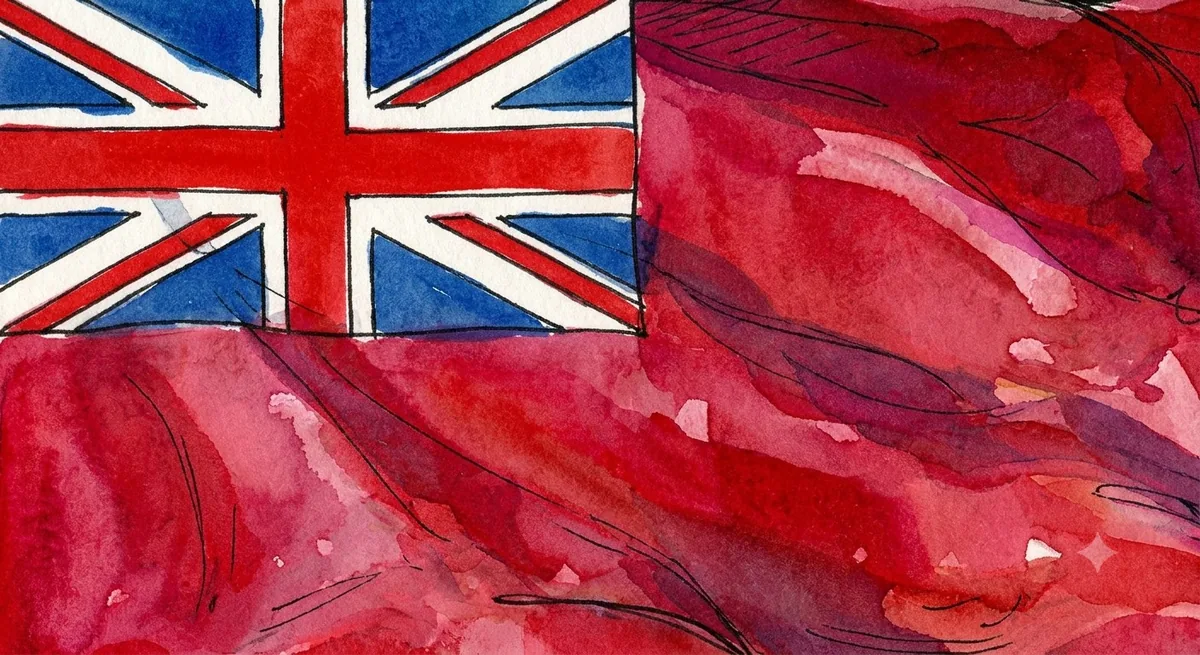
The Red Ensign or Duster was never a banner of military conquest or imperial overreach; it was the mark of merchant mariners, representing the quiet, continuous flow of honest commerce. Long before the modern administrative state, it flew over a civilization anchored by a foundational commitment to peace, order, and good government.
Sovereignty requires only one thing: consistency between our private conduct and public demeanor, anchored by reason, civility, and quiet efficiency.